Your cart is currently empty!
Search results for: “R”
-

Beware of Proprietary Security Systems
Would you be happy purchasing security equipment from a company and being stuck using their service exclusively, even if the service is poor or the price keeps increasing?
It could happen, especially if you purchase ADT, Xfinity (Comcast), or Simplisafe security equipment. Simplisafe and Xfinity even claim a benefit of not requiring a monthly contract. But the fact is, if you aren’t happy with their service, you’ll need to throw the equipment in the trash – because no other company can take it over and monitor it. Their technology is proprietary.
These companies make their proprietary equipment quite attractive with huge sales or “free” equipment.
But that comes at a cost:
- A lengthy contract that rolls the equipment cost into the monthly payment
- No way out because no other company can take it over
Let me ask the obvious question:
If the company locks you into a monthly contract or locks other companies out of monitoring the equipment, what incentive do they have to offer you good service once the sale is complete?
The answer is simple – They have no incentive.
For these reasons, EMC Security gives proprietary equipment a thumbs down. We want our customers to CHOOSE to do business with us. That’s why we give them the freedom to cancel at anytime for any reason – with no penalty. The equipment is non-proprietary so many companies can monitor it.
Click here to schedule a quick, easy takeover today.
-

What to do if You Hear Someone Breaking Into Your House
We all get shaken a little when the alarm is triggered – even if it’s a false alarm – right? But if it’s an actual break-in, and you’re there, it’s serious.
No matter what, don’t put yourself in danger. It’s a really bad idea to confront a burglar. You don’t know if they are armed or not
so try to make the safest decisions. Your job is to protect yourself and your family.Here’s how:
- Shh…BE QUIET! Don’t alert the intruder that you are in the house. At this point, the best plan
it to quietly find your phone so you can make some calls.
- If Your Alarm Panel is Nearby (assuming it wasn’t armed), Press the Panic Button. This will make the sirens to go off and will immediately alert the authorities that you need help. It could also scare the burglar off.
- Find a Way to Get Out of There. If you can escape safely, do it. Try and identify where the intruders are and then leave through a door or window as far away from them as possible.
- Lock Yourself in a Safe Room. If you can’t exit your home safely, then lock yourself in a room, barricade the door so that the burglar can’t enter even if they are able to unlock the door.
- Call the Police. If you don’t have a security system or can’t get to the panic button, make the call as soon as possible.
- Wait. Don’t leave the safe room until the police give the all-clear.
What If You Encounter the Burglar?
- Don’t be a Stupid-Hero. Let them take whatever they want as long as they leave you and your family alone. The sooner they get what they want, the sooner they’ll leave. Never try to stop a burglar from taking anything because you don’t want to trigger any violence.
- Don’t provoke them. This can be difficult when you are feeling violated. But don’t initiate physical violence to catch a burglar. Stay as far away from a burglar as possible. You should only fight back if you are attacked.
- Get a good look. As discreetly as possible, take mental notes of their physical features (height, build, hair, eye color, ethnicity, distinct markings) and mannerisms (accent, walking style) so you can provide the details to the police.
Knowing what to do during a home intrusion is vital to your safety and that of your family. By installing a home security system, you could avoid a frightening and potentially life-threatening situation. Contact EMC Security today for a quote and/or free home evaluation at 770.963.0305.

- Shh…BE QUIET! Don’t alert the intruder that you are in the house. At this point, the best plan
-

I’ve Been Robbed. What Do I Do?
If you’ve just suffered a home burglary you may simply be asking what do I do now?
Whether you’re in panic mode or you’re just not sure where to turn, learn what to do immediately after a home burglary, these tips will help you get through the process as quickly and painlessly as possible.
Step 1. Call the Police
The first thing you should always do after a home burglary is to call the police. If your security system was armed – triggering an alarm, we will contact the authorities for you.
- If you’ve left the house and/or you think the intruder may still be there: This is an emergency. From your locked car or a neighbor’s house, dial 911.
- Any delay to call the police could the lower their chances of catching the perpetrator and recovering your stolen items.
Step 2. Survey your property and possessions
Once the authorities arrive at your home, make a detailed and complete list of everything that has either been damaged or stolen. Include as many details as you can about each item and their value. Give this list to the police and save additional copies for your own records, as well as your insurance company.
It’s also a good idea to take photographs or provide video footage of your damaged property. It’s likely that you will need to provide proof to your insurance company of items that were taken or damaged in the process.
Step 3. Call your insurance company
Assuming you have insurance, you will need to file a claim within 24 hours of filing a report with the police, so it’s important to notify them as soon as you can. In most cases, a claim adjuster will come and inspect your home and any associated damage that may have been caused, so it’s essential that at this stage not to move or touch anything unless you’ve been instructed to do so by the police.
Step 4. Call your bank
After you’ve called the police and spoken to your insurance company, you’ll need to call your bank if any of your credit/debit cards or checks were stolen. Likewise, if a computer, tablet, or phone with banking information and financial data was taken, you’ll need to share this information with your bank as well. It’s important that you call your bank and financial institutions as soon as possible to avoid fraud or any additional theft.
Step 5. Notify others
Consider everything that was taken and who else you may need to notify:
- If your driver’s license was taken you should apply for a replacement immediately.
- If your passport was taken notify the office that issued your passport to cancel it, then apply for a new one.
- If your mobile phone was stolen, notify your network provider right away, so that they can block the phone from being used.
- Notify your neighbors of the burglary to see if that may have witnessed anything.
Step 6. Take care of yourself
Besides simply losing valuables and causing damage to your home, burglaries can leave you and your loved ones feeling vulnerable, unsafe and emotionally shaken. Once you’ve taken all of the immediate actions, you need to channel your attention to taking care of yourself and your family.
Step 7. Apply preventative measures
Installing a monitored security system and/or security cameras can help make you feel safer and secure in your own home and reduce the risk of a second home burglary.
Contact EMC Security to take preventative measures and make your home safer in the future. Check out our blog for other helpful security tips to prevent your home from being burgled again.
-

Best locations for your security cameras
60% of burglars would consider the presence of security cameras when selecting a target, and more than 40% said that cameras are a factor in choosing another target.
Law abiding people don’t tend to consider the mind of a burglar. But the fact is, most thieves know more about home security than the average
home owner . So it’s important to know the best place to put a security camera so they skip your home and move on, away from your property. Learn more from the video below.Front Door
- Because most burglars try the front door first, installing a security camera here is a great way to deter them before they try to get in.
- Place your camera above the door, about 7 feet up, at a downward angle to best record facial images.
Side and Back Doors
- If the front door isn’t an option, the burglar will most likely try a side or back door. Reports show that 22% of burglars enter through the back door because they know that in most homes the back door is not as secure as the front.
- If there is a window at the door, position the camera so that it covers them both.
- It’s also a good idea to position a camera to cover your entire backyard and any out-building you may have.
Windows
- Approximately 23% of burglars will break into a home from a
first floor window if they can’t get in through a door. Windows at the back or side of the house are the most vulnerable. - This is also a good place for an indoor camera placed on a table focusing on the window and anything that might crawl through.
Garage
- Approximately 9% of burglars get in the house through the garage so consider pointing a security camera at your garage doors.
It’s important to remember that security cameras are not a replacement for monitored home security systems. They are to simply add an extra layer of security. If you want to feel safe and secure inside your home, you should purchase a security system with professional monitoring so if an intruder gets inside, you will have help – quickly.
-

What To Expect With Professional Installation
EMC Security’s professional installation, you get white-glove service from start to finish.
While in your home, the technician will:
- Install your customized security system and any optional equipment ordered
- Test all devices to ensure the system works properly and communicates with EMC Security’s monitoring centers.
- Assist you with app download and set-up if applicable
- Conduct training on the use of the system. Now is a great time to ask questions.
- Provide EMC Security yard signs and window stickers
- Obtain your signature on the EMC Security professional monitoring agreement
- Complete the Certificate of Professional Monitoring for burglary (and fire as needed) for insurance discounts
-

Does Your Contract Auto-Renew?
Have you ever sign up for a subscription or on-going service and then get surprised by a renewal charge that shows up on your credit card bill weeks later? Have you gotten discouraged when you can’t figure out how to cancel? Or it’s too late to prevent the charges?
It’s called automatic renewal, and the practice is showing up more frequently in consumer contracts for all sorts of services and products. It’s happening everywhere from entertainment subscriptions to gym memberships to home security.
If you’re unwittingly auto-renewed into a new contract with a home security company and want to challenge the agreement — you’re not alone.
Georgia law requires every customer to be notified between 30 and 60 days of the original expiration date of the contract. The notification must clearly state that the contract is renewing. It must also provide clear instructions on how to cancel service if they do not want the contract to automatically renew for any term more than month to month.
Most companies are following state regulations on notification of a contract term in the original agreement. However, fewer are properly following the requirement of notifying customers that their contract is automatically renewing for more than a one-month term.
If you find yourself in this situation, check to see if you’ve received this type of written notification within the required time period. If not, you can dispute the auto-renewal and get out of the renewal without penalty.
Once you’re free from the binds of the agreement, you can resecure your home protection with EMC Security’s no-contract required policy.
Click here to download a full copy of the Georgia Auto-Renewal Law.

-

Upgrading to 5G Technology
What’s this 5G all about? And what does it mean for me?
The 5G upgrade is applicable for customers that utilize a cellular connection from their security system to EMC Security. Other systems (land phone line and wifi/internet) are not affected.
What is 5G? The G in 5G stands for “Generation.” 5G is the fifth generation of wireless network cellular technology, replacing the current 3G networks. It is reputed to be ultra-fast (for example, you will be able to you download a full-length movie to your mobile device in seconds) and more reliable.
What is LTE? Short for “Long Term Evolution”, LTE is a standard of wireless data transmission that includes 4G and 5G technology.
What’s happening? The cellular companies are sunsetting the older 2G and 3G networks, and moving to a faster, more reliable 5G network. Plans are to have this accomplished by the end of 2022.
How does this affect my alarm system? If your system communicates with EMC Security through cellular connection, in order to be compatible with the new 5G network, the cellular radio device in your security system will need to be replaced with the latest technology.
As an EMC Security residential customer, this required upgrade is completely FREE. Your security protection will continue with the latest technology with no cost and no hassle.
How will I receive the upgrade from EMC Security? Over the next several months, you will receive a phone call from an EMC Security representative explaining the process and setting up an in-home appointment with a technician. We’ve been installing 5G LTE radios for over a year so not all customers are affected.
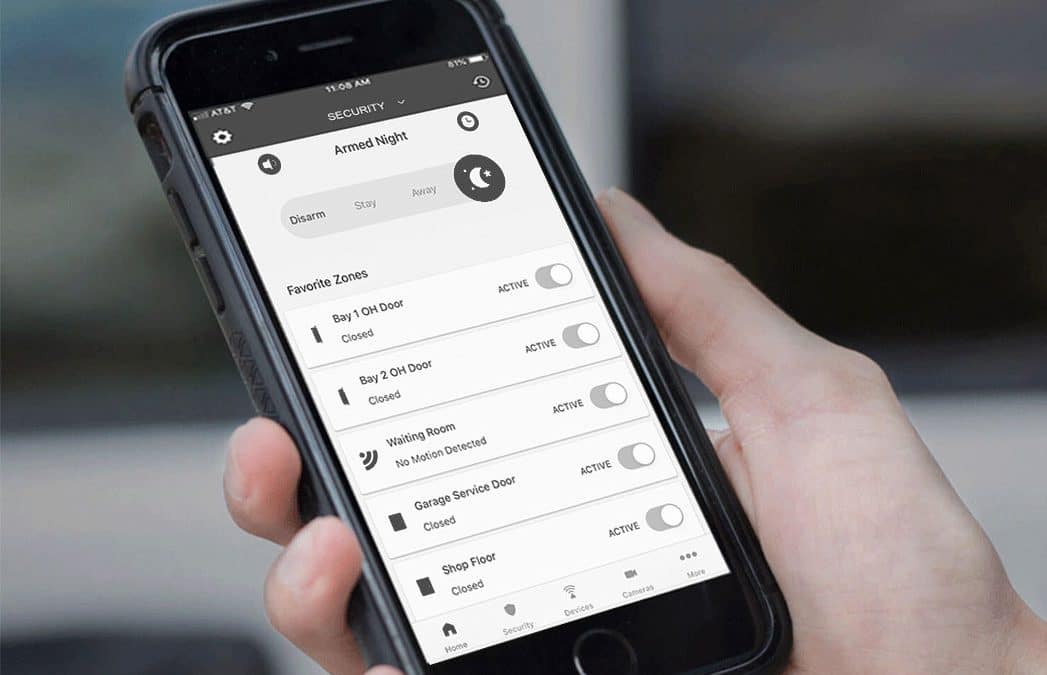
At this time, if you are not using the EMC Security mobile app, it’s a great time to discover the benefits of staying connected to your home remotely.
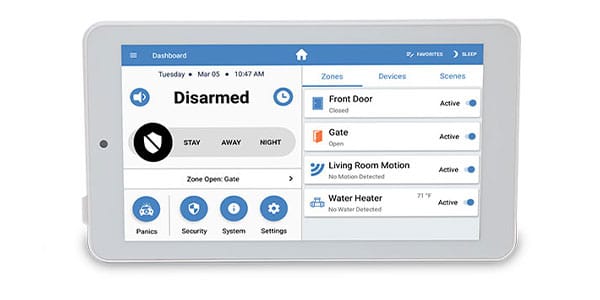
It might also be a good time to upgrade some older equipment, such as your keypads. You can swap your keypad for a new color touchscreen that integrates all your smart-devices and cameras, as low as $99 each.
-
March, 2021
Complete this form to request replacement signs. THEY’RE FREE!
What’s this 5G all about? And what does it mean for me?
The 5G upgrade is applicable for customers that utilize a cellular connection from their security system to EMC Security. Other systems (land phone line and wifi/internet) are not affected.
What is 5G? The G in 5G stands for “Generation.” 5G is the fifth generation of wireless network cellular technology, replacing the current 2G and 3G networks. It is reputed to be ultra-fast (for example, you will be able to you download a full-length movie to your mobile device in seconds) and more reliable.
What is LTE? Short for “Long Term Evolution”, LTE is a standard of wireless data transmission that includes 4G and 5G technology.
What’s happening? The cellular companies are sunsetting the older 2G and 3G networks, and moving to a faster, more reliable 5G network. Plans are to have this accomplished by the end of 2022.
How does this affect my alarm system? If your system communicates with EMC Security through cellular connection, in order to be compatible with the new 5G network, the cellular radio device in your security system will need to be replaced with the latest technology.
As an EMC Security customer, this required upgrade is completely FREE. Your security protection will continue with the latest technology with no cost and no hassle.
How will I receive the upgrade from EMC Security? Over the next several months, you will receive a phone call from an EMC Security representative explaining the process and setting up an in-home appointment with a technician.
At this time, if you are not using the EMC Security mobile app, it’s a great time to discover the benefits of staying connected to your home remotely.
It might also be a good time to upgrade some older equipment, such as your keypads. You can swap your keypad for a new color touchscreen that integrates all your smart-devices and cameras, as low as $99 each.
REFER A FRIEND. REWARD YOURSELF!
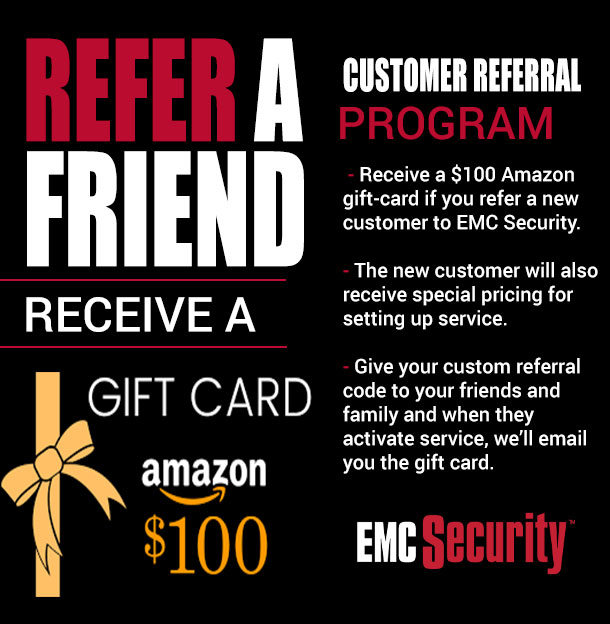
Receive a $100 Amazon gift-card when you refer a new customer to EMC Security.
Simple Process: Give your friends and family your custom coupon code to use when purchasing security service. This code will identify you as the customer that referred them.
We’ll also extend special “referral pricing” to whomever you refer as a thank you.
Unlimited entries! The more you refer, the more gift-cards you can earn. Program expiration date: May 30, 2021
Do you have missing or damaged yard signs?
Request Yard Signs Now >>
The 2021 Valor Awards, hosted by Gwinnett Chamber honors the men and women who have performed heroic and extraordinary acts to protect and serve the citizens of Gwinnett. EMC Security is pleased to be a part of this memorable event.
-

6 DIY Projects To Do During COVID
With many states, counties, and cities still in semi-lock down, people are spending much more time at home. Rather than binge-watching your favorite TV series, again and again, we’ve come up with some amazing DIY projects to keep you occupied during COVID.
- Add a Splash of Color to Your Walls
This can be as simple as retouching an existing paint job or as complex as painting every wall. Consider how each room makes you feel and what colors evoke positive and happy emotions when you see them.
- Rearrange Your Home
Whether you are into altering the vibes or just want to refresh your bookshelves rearranging your things can be a great project. It allows you to re-evaluate what you have and reconsider how you’d like to have them displayed.
- Eliminate the Dust
This may be a daunting task but the time has come to clean the random things we forget about. This would include, blinds, vents, fans, the oven! Deep cleaning can be done in segments so don’t feel overwhelmed thinking about the last time you got to it.
- Organizing
Now that you know where things are, it’s time to organize inside your cabinets and closets. Take time to purge your home of some of the things you’ve been collecting subconsciously.
- Go Through Your Storage
Practically every household has a junk draw or in some cases, a junk room full of random things. Now is the perfect time to go through what you have been storing and decide if those things still need to be in your life.
- Wash Everything
Wash all your linens, curtains, towels, cars, dishes. Take time to just make sure everything in your home is freshly laundered or clean. It can be a project you take on day by day. Now you won’t have to question when the last time something was washed.
In Conclusion
In conclusion, we hope you continue to stay safe during these uncertain times. We hope that you enjoyed our list of DIY projects to do during COVID.
-

Professional vs Self Alarm Monitoring
One of the most important decisions when buying a home security system is whether to pay a monthly fee for professional monitoring or save money and self-monitor your system.
Although self-monitoring is a cheaper option, there are reasons to consider a professionally monitored system from EMC Security:
1. The EMC Security central monitoring service is watching around the clock, every hour, every minute, every second your alarm is armed, to ensure authorities are notified as quickly as possible. Average response is 14 seconds!
2. Two words – Fire Protection. Did you know that EMC Security monitors customers homes for smoke and heat at no additional monthly cost? Simply add an EMC Security smoke detector and integrate with your security system and if there’s a fire, you’ll be notified whether at home or away.
At home or away, awake or asleep, EMC Security’s got your back. Call today to set up professional monitoring at your home today.